
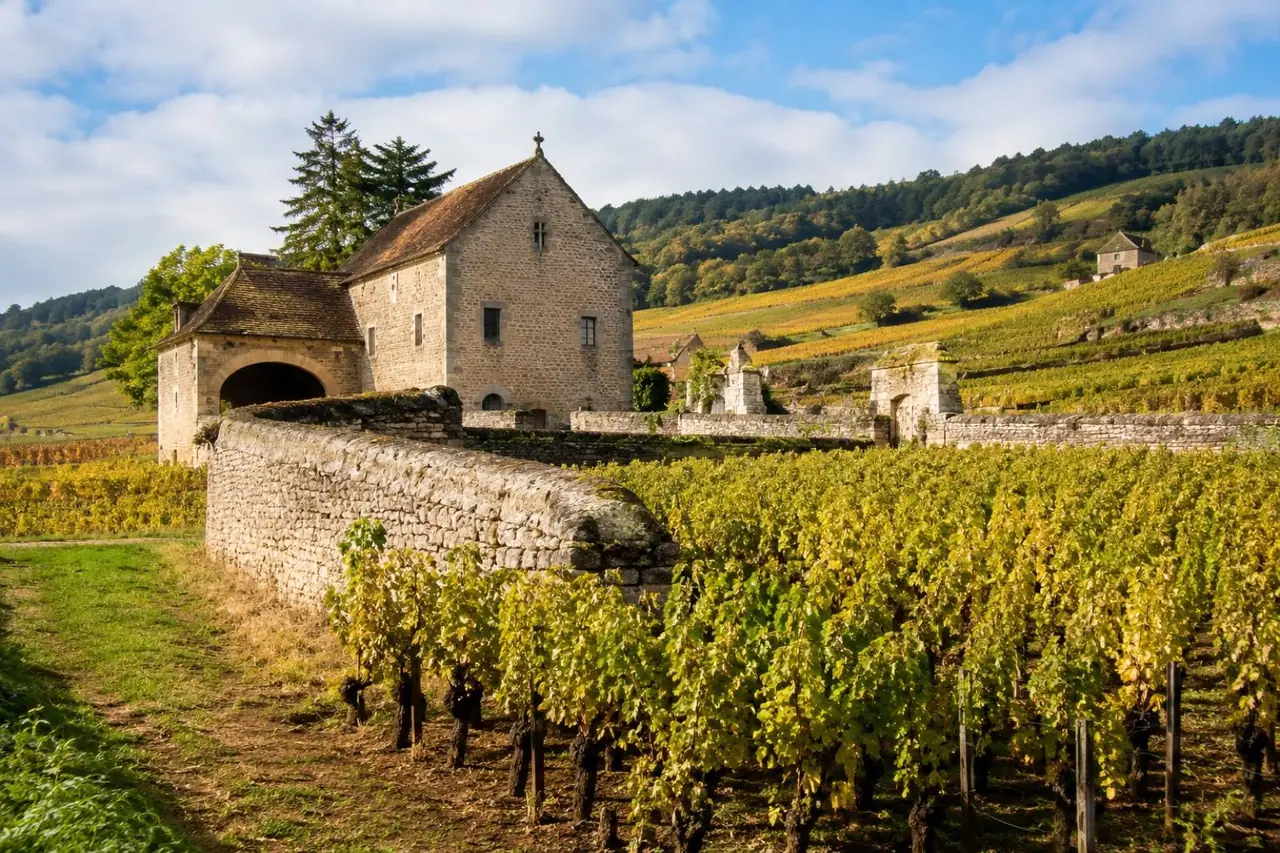
A Burgundy Getaway: Our Favourite Spot
Few wine regions in the world pack as much history, precision and diversity into such a small territory as Burgundy. A strip of hillsides less than 30 miles long, between Dijon and Chagny, shapes some of the most sought-after, and most expensive, wines on the planet.
This is a region that rewards patience. There are no sprawling American-style estates here, no flashy marketing, Burgundy cultivates a kind of discretion, almost restraint, that makes every discovery all the more precious. Here's why this region remains, time and again, our favourite spot.
Two grapes, endless nuance
Burgundy bets on purity: Pinot Noir for reds, Chardonnay for whites, almost never blended. Where Bordeaux masters the art of blending several grapes, Burgundy takes the opposite bet: a single variety, exposed with no safety net, whose every nuance depends entirely on the terroir that shaped it.
This apparent simplicity hides remarkable complexity. The smallest change in soil, exposure or plot dramatically transforms a wine's character, sometimes over just a few meters. That's the whole principle behind Burgundy's "climats": precisely delimited plots, each with its own name, its own history and its own distinct personality, sometimes farmed side by side by different winemakers who draw radically different wines from them.
A UNESCO World Heritage landscape
Since 2015, the climats of the Burgundy vineyard have been listed as UNESCO World Heritage: a rare recognition for a wine landscape, ranking alongside sites like the Great Wall of China or the pyramids of Giza. The distinction doesn't just honor a landscape: it celebrates a classification system unlike any other in the world, refined over nearly a thousand years.
This know-how was passed down from the Cistercian monks of the Middle Ages, notably settled at the Abbey of Cîteaux, among the first to precisely map the region's best plots, noting, century after century, which patches of land consistently produced the finest wines. This empirical mapping gave rise, much later, to the modern hierarchy of appellations: village, premier cru, grand cru.
From the Côte de Nuits to the Côte de Beaune
The Côte-d'Or, the beating heart of Burgundy's wine country, splits into two distinctly different moods.
To the north, the Côte de Nuits is Pinot Noir's kingdom, with names that make wine lovers dream the world over:
Further south, the Côte de Beaune balances elegant reds with exceptional whites: this is where some of the world's finest white wines are born:
Two moods, two styles, one exceptional terroir. The Côte de Nuits seduces with tannic power and aging potential; the Côte de Beaune, with finesse and minerality. It's hard to pick a side, and that's exactly what makes the region so fascinating to explore, glass after glass.
Want to explore these terroirs glass in hand?
Discover our sommelier-guided wine tastings and courses in Paris.
Discover our experiences